Event 1
Lycaon’s transformation into a wolf

[Lycaon’s transformation into a wolf](entity:event-recall-event-lycaon-s-transformation-9165e956802b) is the foundational metamorphosis through which the book traces the werewolf’s passage from ancient myth into later folklore, poetry, and short fiction. In Ovid’s Metamorphoses, Lycaon’s ferocity leads Jupiter to deprive him permanently of human form; the punishment is not merely an external disguise but a conversion of body, appetite, movement, and social identity. The episode therefore supplies a durable literary grammar for the werewolf: the human being becomes an animal while recognizable remnants of the former person remain visible within the transformation.
## Mythic Background and Punishment
The episode belongs to the ancient poetic history of the werewolf, long before the monster acquired its later German, French, English, and Germanic names. The book places it within a wider claim that modern monsters germinated from superstition, developed through folklore and legend, and eventually entered literature. Werewolf beliefs already existed in Greek, English, Italian, German, and French traditions at the beginning of the nineteenth century, but Ovid’s account is treated as an especially important literary ancestor because it gives transformation a fully developed poetic form.
Lycaon’s change is imposed by Jupiter after Lycaon has become so ferocious that his nature is judged wolf-like. The punishment reaches beyond death or temporary disguise: he is deprived of ever attaining human form again. This permanence distinguishes the episode from a simple costume change or a reversible enchantment. Lycaon crosses a boundary between human and animal and is left on the animal side of it, making the metamorphosis both a moral judgment and an irreversible alteration of identity.
## The Transformation of Body and Appetite
Ovid’s translated passage describes the change through a sequence of physical substitutions. Lycaon flees in terror into the silence of the countryside, where he can no longer speak. His desire for the slaughter to which cattle had once been subjected continues, but it is now joined by delight in blood. The transformed figure therefore retains a violent impulse while acquiring the feeding habits of the wolf; the punishment makes his inward ferocity legible through animal appetite.
The body then changes piece by piece. His garments pass away into hairs, his arms become legs, and he becomes a wolf. Yet the metamorphosis does not erase every human trace. The poem preserves the marks of the former shape, including the same grayness and the same fierce appearance. The result is a hybrid image rather than an entirely unrelated animal: the wolf is visibly continuous with the punished man, and the continuity makes the transformation recognizable.
The loss of speech is equally significant. Lycaon wants to speak but cannot, so the transformation removes the human faculty through which guilt, explanation, or appeal might be expressed. His remaining communication is animal flight and behavior. The episode thus links bodily transformation with the collapse of human language, presenting the werewolf as a figure whose former identity survives in appearance and appetite but not in ordinary speech.
## Literary Afterlife and Type Formation
The book identifies the described conversion of clothes into wolf hair and arms into legs, together with the inability to speak, as the first example of its kind in recorded poetry. That assessment makes Lycaon’s transformation more than an isolated mythic incident: it becomes a template for later representations of shapeshifting. The episode supplies the sequence of moral transgression, divine or supernatural punishment, bodily change, altered appetite, and incomplete erasure of the human form.
A thousand years later, poets of the Middle Ages continued the lycanthrope legend. The book points to the late twelfth-century Roman de Guillaume de Palerne, later translated as William and the Werwolf, and to the thirteenth-century French poet Marie’s Lai du Bisclavaret. The latter is specifically identified as a werewolf poem whose lines were quoted at the beginning of The Wehr-Wolf: A Legend of the [Limousin](entity:location-recall-location-limousin-92ef43f4c0a4). These works show the legend moving through different languages and literary settings while retaining the central problem first made vivid by Ovid: how a human identity persists, or fails to persist, beneath an animal form.
The werewolf also entered English poetic tradition through Michael Drayton’s The Moon-Calf, written in the late sixteenth or early seventeenth century. There the fierce wär-wolf is associated with a thirst for the blood of cattle, extending the older connection between animal violence, blood, and supernatural fear. By the nineteenth century, the monster made its greatest literary advance from poetry into the short story. The period from 1800 to 1849 is described as the cradle of werewolf short stories, even though relatively few such works were written and novels about werewolves remained scarce.
## From Metamorphosis to Folklore
Later folklore preserves several elements already visible in Lycaon’s transformation. In the account cited from The Menageries: Quadrupeds, the were-wulf is described as a sorcerer who applies an ointment, puts on an enchanted girdle, and appears to others as a wolf while also believing himself to possess the wolf’s shape and nature. Unlike Lycaon’s divinely imposed punishment, this version emphasizes sorcery and a transformation mediated by an object. Nevertheless, both accounts make the change affect perception, nature, and behavior rather than outward appearance alone.
The same folklore tradition explains why wolves were imagined as especially demonic predators. Once a wolf had tasted human flesh, it was said to prefer human flesh to every other food. This belief helped turn ordinary wolf behavior, including attacks on livestock and the disinterment of corpses during severe winters, into evidence of supernatural possession. In the countryside around Ashford, real wolves entering a cemetery through a breach in its walls and a mendicant’s accidental death at a carved stone cross were attributed to the Wulfrics under their supposed guise of wer-wolves. The narrative pattern echoes Lycaon’s transformation by allowing physical evidence of animal violence to be interpreted as proof of a human being’s monstrous alteration.
The same process appears in later fictional persecution. In 1588, suspicion against [Michael Thilouze](entity:character-recall-character-michael-thilouze-09e43fb3450c) and Francoise Thilouze grows after the Marquis de Montmorenci and the Count de Vardes turn against them. A rumor claims that Francoise, when seen walking with [Victor de Vardes](entity:character-recall-character-victor-de-vardes-6b5850623859) in remote parts of the domain, suddenly changed into a wolf and ran away. The story is not established as fact; it is a socially manufactured accusation, strengthened by the belief that witches could become wolves, cats, or hares and by the presence of a large wolf that had escaped the foresters’ guns. Here the ancient metamorphosis becomes a weapon of communal suspicion: the wolf’s shape is projected onto a vulnerable person by those seeking confirmation of an existing prejudice.
## The White Wolf and Repeated Pattern
The book’s later embedded narrative repeats the structural logic of Lycaon’s transformation through the white wolf’s lure in the [Harz Mountains](entity:location-recall-location-harz-mountains-853d0c0ed0e6). A hunter follows a large white wolf for several hours as it retreats, pauses, snarls defiance, and then moves away again. The chase carries him upward into an open space in the pine forest believed to be inhabited by evil influences. When he approaches closely and raises his gun, the wolf suddenly disappears. The scene preserves the older pattern of pursuit, boundary crossing, and the collapse of ordinary explanations, although its transformation is withheld from the hunter rather than shown directly.
The same story also distinguishes an actual animal from the supernatural horror that may use animal form. A later attack ends with the naked form of [Krantz](entity:character-recall-character-krantz-2ce5df9fe58b) being carried away by an enormous tiger through the jungle. This is not Lycaon’s transformation, but it demonstrates how the book repeatedly separates ordinary predators from the human or supernatural identity attached to them. The wolf, white wolf, were-wolf, and tiger occupy different narrative functions; together they show how animal behavior, human violence, and supernatural judgment can be made to overlap without becoming identical.
## Narrative Significance
Lycaon’s transformation establishes the metamorphosis plot as a moral and bodily reversal. A man whose conduct has become wolf-like is made literally wolf-like, and the punishment externalizes what was already present in his violence and appetite. The event’s power lies in the tension between continuity and rupture: the old form disappears, yet its traces remain; speech fails, yet the desire to speak survives; human identity is condemned, yet it remains visible in the wolf’s appearance.
That tension helps explain why the episode remains central to the book’s history of the werewolf. Later stories alter the cause of transformation—divine punishment, sorcery, an enchanted girdle, inherited suspicion, or supernatural pursuit—but repeatedly return to the same questions first crystallized in Ovid’s poem. What makes the wolf human, what makes the human monstrous, and whether a transformed being can ever return are questions carried from ancient poetry through medieval lays, early modern folklore, and nineteenth-century short fiction. Lycaon’s permanent loss of human form supplies the earliest decisive answer: transformation becomes punishment when it makes outward nature permanently reveal inward violence.
Event 2
All Souls’ Eve
[All Souls’ Eve](entity:event-recall-event-all-souls-eve-0bee50e730b8) is the supernatural and emotional threshold of “[Hugues](entity:character-recall-character-hugues-f10a823502dd) the Wer-Wolf,” transforming an isolated family vigil into a confrontation with death that the survivors cannot interpret as natural. Falling on the night before All Souls’ Day, it is presented as the year’s most haunted interval, when the dead are reputed to rise from their graves and return to their homes. Within that charged calendar, grief, superstition, and the unknown converge until Hugues Wulfric’s sister dies at the very moment the household seems to be invaded by the dead.
## Sacred Time and Folkloric Meaning
All Souls’ Eve is defined as a night set apart from ordinary time. The story places it before the later cultural prominence of [Halloween](entity:time-recall-time-halloween-c9b359236295) and describes it as the haunted night of the year, associated with the return of the dead. Its force therefore comes not merely from darkness but from a communal belief that the boundary separating graves from homes has temporarily weakened. The event belongs to a wider history in which supernatural beings emerge from superstition, pass into folklore, and eventually become subjects of literary invention. The werewolf tradition itself is traced through Greek, English, Italian, German, and French sources, with different names for the figure now called the Werewolf and with devils or sorcerers commonly identified as the causes of werewolfism.
The night also gathers several older motifs of transformation and uncertain identity. Medieval and earlier poetry had already described the lycanthrope as a being caught between human and animal forms, including the striking image of clothing changing into wolf hair and human arms becoming legs, while the transformed person wants to speak but cannot. All Souls’ Eve gives this literary inheritance a temporal setting: the night does not simply contain a monster, but makes the world receptive to crossings between the living and the dead, the human and the animal, and the visible and the unseen.
## The Orphaned Vigil
When All Souls’ Eve arrives, Hugues Wulfric and his sister are already marked by recent bereavement. Their parents have died from sickness and poverty, and Hugues has buried them himself, wrapping their bodies in scraps of hemp cloth and covering the grave with only a few clods of earth. Several days later, the orphaned survivors keep watch alone in the hut by a fitful fire. Their mother’s former presence is remembered through the hearth and through the cheerful tales that once animated the household; the same domestic space now becomes a place of exposure and dread.
The setting intensifies the event through a sequence of natural images that seem to acquire supernatural agency. Wind howls along the bleak hillside and whistles through trees stripped of their last leaves. The sun has sunk, fog spreads through the air like mourning, and no star appears in the heavy sky. The hut, recently visited by death, stands as the only enclosure around the two young survivors. Their loneliness is not abstract: it is concentrated in the cold hearth, the empty place of the mother, and the silence that allows every distant sound to become evidence of a returning spirit.
Their fear rises through interpretation rather than immediate sight. The sister believes a shriek has been repeated by every forest echo and imagines the tread of a gigantic phantom whose breath has shaken the door. Hugues admits that he too has heard distant voices murmuring strange words, though he tries to reassure her by reminding her that he is beside her. She asks that they pray to the holy Virgin to restrain the dead from haunting their dwelling. Hugues answers with a protective ritual, throwing onto the fire a holy branch gathered on the previous Palm Sunday, which he believes will drive away evil spirits and allow their mother to enter safely if she is among the returning dead.
## The Apparition of the Dead
The siblings’ conversation turns the night’s folklore into an immediate domestic possibility. Hugues suggests that their mother may be among the unshriven and unshrouded dead, coming to visit her beloved children on the eve when the dead leave their graves. He proposes opening the door so that she may resume her accustomed place beside the hearth. His sister, however, experiences the exterior world as a hostile threshold: the air is damp and cold, the gusts sweep past the hut, and groans seem to issue from the dead around them.
The supposed procession gradually becomes visible and audible through distant signs. Hugues sees pale, lurid lights rising across the marsh and interprets them as the dead coming to sit before a meal prepared for them. The bells of All-hallowtide seem to approach on the gale, mingling with hollow voices. His sister declares that the horror has become unbearable and senses that this will be her last night on earth. Hugues then points again to the lights and hears the prolonged tolling of the bell as confirmation that the dead are coming. The scene’s terror depends on withheld explanation: the siblings recognize omens, but neither they nor the reader receives a stable account of what the sounds and lights actually are.
At the climax, both survivors kneel and bow their heads, invoking eternal repose for the ashes of the dead. Their prayer is answered by an abrupt and violent change in the hut. The door closes with force, as if slammed by a vigorous hand; the timber supporting the roof cracks; the fire is suddenly extinguished; and a plaintive groan merges with the blast entering through the door’s crevices. When Hugues raises his sister, she is dead. The event thus shifts the value of the scene from fearful expectation to irreversible loss: the children feared that the dead might enter, and one of the living becomes dead without a visible assailant or an explained physical cause.
## Consequences for Hugues Wulfric
The death on All Souls’ Eve completes the destruction of Hugues Wulfric’s immediate family. He had already become responsible for two younger sisters after burying his parents; within a fortnight, both sisters descend into the grave as well. After laying the last one in the earth, he considers whether he should lie beside his family and share their peaceful sleep. His grief appears not in public weeping but in mute, sullen contemplation over the rough burial place and the loneliness that now defines his future.
For three consecutive nights, Hugues wanders from his solitary hut, alternately prostrating himself and kneeling on the funeral turf. He has eaten nothing for three days. All Souls’ Eve therefore functions as more than atmospheric decoration or a calendar reference. It is the event that strips Hugues of family, sheltering belief, and ordinary social belonging, leaving him physically weakened and spiritually exposed. The night’s supernatural ambiguity also prepares the later werewolf narrative: death has entered the story through a threshold where ritual, weather, rumor, and bodily fate can no longer be cleanly separated.
## Narrative and Genre Significance
The event exemplifies the book’s account of how werewolf literature developed from inherited superstition into poetry and short fiction. The werewolf was historically described as a human being who, through sorcery, devilish ointment, and an enchanted girdle, could assume both the appearance and nature of a wolf and act with the violence of one. Later literary traditions expanded the figure through stories and poems such as “The Lay of Marie” and “William and the Werwolf,” while the nineteenth century moved the monster decisively from poetry into the short story. All Souls’ Eve provides an especially effective bridge between those traditions because it supplies a folkloric calendar, a ritual atmosphere, and a narrative mechanism for making the dead feel present without displaying them directly.
Its horror is strongest before the final revelation. The story repeatedly offers possible evidence of supernatural visitation—voices, a shriek, footsteps, icy breath, lights across the marsh, tolling bells, and a door moved by an unseen force—while preserving uncertainty about their source. That economy allows superstition to operate as both setting and psychological pressure. The night becomes a contested space between sacred protection and profane intrusion: prayer, the Palm Sunday branch, and the appeal to the Virgin attempt to restore order, but the extinguished fire and the sister’s death show that ritual reassurance cannot guarantee safety. All Souls’ Eve consequently establishes the central imaginative condition of “Hugues the Wer-Wolf”: a world in which the boundary between the human and the monstrous is not merely described by legend, but experienced as a nightly threat to the body, the family, and the meaning of death.
Event 3
Procession of Saint Ursula and the Eleven Thousand Virgins
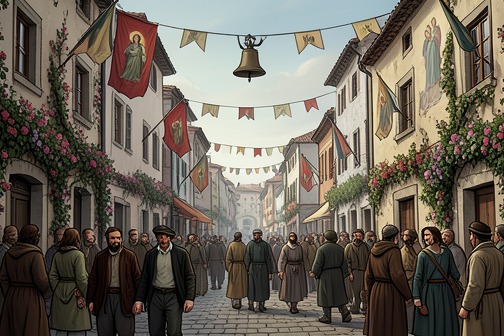
The [Procession of Saint Ursula and the Eleven Thousand Virgins](entity:event-recall-event-procession-of-saint-urs-ccd19c60b592) is the religious festival whose aftermath still governs the town of [Josselin](entity:location-recall-location-josselin-786caabb8f52) when the episode begins. Though ostensibly a ceremony of devotion, it leaves behind a world of crowds, bells, banners, flowers, aristocratic display, and popular fears in which sacred observance and secular appetite are inseparable. The procession therefore serves not merely as background: it establishes the unstable ceremonial atmosphere through which later violence, desire, and supernatural suspicion become intelligible.
## Festival and Setting
Three days after the grand procession in honor of Saint Ursula and the other virgin martyrs, Josselin has not returned to its customary repose. The bells of [Notre Dame du Roncier](entity:location-recall-location-notre-dame-du-roncie-44180af6e46c) continue to ring at intervals, as though the feast itself has forgotten to end. Crowds still roll through the streets, meeting and separating; banners hang from windows; and flowers and branches remain spread across the walls. The festival survives as a residue in the town's physical appearance and public movement, turning ordinary time into an extended period of ceremonial suspension.
The procession has also drawn participants from several social ranks. Beautiful young women, carried in litters or riding palfreys, begin to leave the scene, while high-born attendants travel homeward amid the chivalry of the province. Their glances toward the monastic enclosure suggest that the religious spectacle has temporarily released them from, and now returns them to, confinement. Village girls who had been admitted because so many virgins of noble rank could not be found wave their bluebell chaplets in farewell. The festival thus joins aristocratic and humble participants without erasing the hierarchy that separates them.
## Sacred Spectacle and Popular Fear
As evening approaches, the departing village women look anxiously for the wandering fires of the sotray and the dwarfs said to dance at night around the peulvan. The religious procession has not displaced older supernatural beliefs; instead, it coexists with them. Christian ceremony, local legend, and nocturnal apprehension occupy the same landscape, so that the sacred and the uncanny become adjacent forms of public experience.
This mixture gives the event a threshold quality. The procession belongs to a recognized religious order, but its fading leaves the town exposed to forces that official ritual does not fully control. The continuing bells imply institutional continuity, while the fearful search for wandering fires and nocturnal beings reveals a popular imagination that remains alert to the supernatural. In this setting, the boundary between devotional observance and terror is porous rather than secure.
## Aftermath and Civic Ritual
The remaining crowds provide the setting for the annual ceremony of ducking the fishermen, which takes place on the day the history begins. The riverbank fills with ladies, knights, squires, local chatelaines, priests, bourgeois, and villeins. Minstrels, trouveres, and jongleurs sing, play cymbals, and recite stories, while tables of food, wine, and hippocras transform the public gathering into a feast as well as a spectacle.
The ceremony makes the festival's social order visible through punishment and enforced submission. Judges enter amid banners and official pomp, then proclaim that anyone who sold fish taken from the river during [Lent](entity:time-recall-time-lent-829027562545) must appear personally or by proxy and perform a somerset into the river. Refusal carries a fine of three livres and four sous. The required plunge is presented as both entertainment for the crowd and a token of fealty to the lord of the fief, revealing how public amusement, legal authority, economic regulation, and feudal obedience are folded into one ritual act.
The crowd's laughter intensifies the humiliation. Fish merchants answer the summons with different forms of resistance: some meet the ridicule with good humor, some appear solemn and sullen, and others openly regard the swollen, turbulent water with hostility. Some are accompanied by older female relatives who encourage them, while others are driven onward by the sheathed swords of their masters. The ceremony therefore stages unequal power in comic form, making submission pleasurable to spectators even when it is frightening or degrading to those compelled to perform it.
## Narrative Significance
The procession's importance lies in the contrast between its formal religious unity and the disorder that follows in its wake. Its bells, images, and communal pageantry promise a stable sacred framework, yet the town remains crowded with competing desires, class tensions, inherited legends, and fears of the night. The ceremony's conclusion does not restore ordinary life; it leaves Josselin in a charged interval where festive display continues while apprehension grows.
That interval prepares the story's recurring concern with ritual as a means of controlling uncertainty. The procession organizes bodies in public space, the river ceremony disciplines subjects before a crowd, and later episodes use secret meetings, marriage oaths, ecclesiastical forms, and public execution to mark or enforce changes of identity. Against this background, the Procession of Saint Ursula and the Eleven Thousand Virgins becomes the first large ceremonial structure in the episode: a spectacle that appears to impose order while exposing how close order remains to violence and the supernatural.
Event 4
Krantz’s double murder and flight to the Hartz Mountains
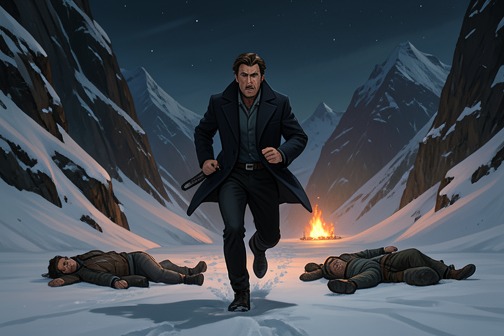
[Krantz’s double murder and flight to the Hartz Mountains](entity:event-recall-event-krantz-s-double-murder-23e509b53a6d) is the decisive origin event in the family’s later history. It joins sexual betrayal, retaliatory violence, social inequality, and exile in a single catastrophe: a serf who has risen to wealth and stewardship remains legally powerless, and his attempt to answer a private wrong becomes a flight from an entire political order.
## Social and Family Background
[Krantz](entity:character-recall-character-krantz-2ce5df9fe58b) recounts the event as part of his family history, while carefully distinguishing what he personally witnessed from what he learned afterward. His father was not originally from the Hartz Mountains. He had been a serf belonging to a wealthy Hungarian nobleman in [Transylvania](entity:location-recall-location-transylvania-1fbd2e67da43), yet he was neither poor nor illiterate. His intelligence, respectability, and material success had earned him promotion to the position of steward. The promotion changed his duties and standing but not his legal identity: however wealthy a person born into serfdom might become, he remained a serf.
That unresolved contradiction determines the family’s fate. Krantz’s father possessed the resources and competence of a respected household officer, but he could not expect the authorities to treat him as the social equal of the nobleman who held power over him. The later murder is therefore not presented as an isolated domestic crime. It occurs within a hierarchy in which the injured husband knows in advance that his status will deprive him of a fair defense.
At the time, Krantz’s father had been married for approximately five years. The marriage had produced three children: the eldest son, [Cæsar](entity:character-recall-character-c-sar-5c74f9f519b5), Krantz himself, and a daughter named Marcella. Their Latin-derived names reflect the cultural setting in which Latin was still spoken. The household’s apparent stability was destroyed when Krantz’s mother attracted the attention of the lord of the estate.
## Discovery and Double Murder
Krantz’s father was sent away on a mission, leaving his wife exposed to the nobleman’s persistent attentions. She was flattered by his interest and eventually yielded to his wishes. The decisive fact was not rumor or suspicion. His father returned unexpectedly and found her in the company of her seducer, giving him direct and positive evidence of the affair.
The discovery produces the event’s immediate reversal. A husband who had occupied a trusted position within the nobleman’s household becomes an avenger against that same ruling class. Overcome by the force of his feelings, he waited for an opportunity when the two could meet and then murdered both his wife and her seducer. The double killing thus answers one betrayal with another rupture of the social order: the nobleman’s abuse of privilege and the wife’s infidelity are met by violence that the law will not excuse.
Krantz does not present the murder as legally defensible. His father understood that, as a serf, even the provocation he had suffered would not be accepted as a justification. That awareness gives the scene its grim precision. The act is driven by personal outrage, but its aftermath is calculated under the pressure of class law. The father knows that the same deed might be judged differently in a different social position; for him, discovery means not only grief and rage but certain pursuit.
## Flight from Transylvania
Immediately after the killings, Krantz’s father gathered whatever money he could seize, harnessed his horses to a sleigh, and took his children with him. It was the depth of winter, and the family departed in the middle of the night. The timing and method of escape show that flight was not a later decision but the continuation of the murder itself: the father had to convert a household into a moving refuge before the authorities learned what had happened.
He understood that he would be pursued and that no part of his native country offered a genuine chance of escape. Within Transylvania, the authorities could still seize him. He therefore continued without interruption, moving away from the jurisdiction that defined him as a serf and into the secluded intricacies of the Hartz Mountains. The mountains become both geographical destination and social counter-space: a place where a hunted family can disappear after the law has made ordinary residence impossible.
Krantz’s own knowledge of this portion of the story is retrospective. He states that he learned the details afterward, so the murder and flight reach the reader through family testimony rather than direct eyewitness narration. His earliest memories begin only after the escape, in a rough but comfortable cottage on the edge of the vast forests covering northern [Germany](entity:location-recall-location-germany-2e3723c2f347).
## Consequences and Narrative Significance
The flight relocates the children from Transylvania to an isolated German household. Their father purchases the cottage and surrounding land from a forester who earns a living by hunting and by burning charcoal to smelt ore from neighboring mines. The property lies about two miles from any other habitation. A few acres provide a doubtful but sufficient summer harvest, while winter confines the family indoors; because their father follows the chase, the children are sometimes left alone as wolves prowl continually outside.
This settlement is therefore not a clean escape from danger. It preserves the family, but it also places them in a landscape of isolation, hunting, wolves, and uncertain subsistence. The domestic refuge created by the flight carries the atmosphere of the original crime forward into a new environment. Transylvania is left behind geographically, yet the consequences of the murder remain present in the family’s separation from society and in the precarious life that follows.
The event also establishes the inherited structure of Krantz’s story. A father’s violent response to betrayal saves his children from immediate capture but exposes them to exile and embeds their future in a history of pursuit, concealment, and moral judgment. The double murder is consequently more than a backstory incident: it is the family’s founding wound, the cause of its removal to the Hartz Mountains, and the first link in the chain by which violence and displacement pass into the next generation.
Event 5
Krantz’s cursed marriage oath to Christina
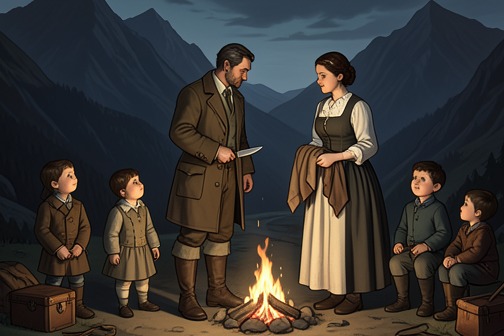
[Krantz’s cursed marriage oath to Christina](entity:event-recall-event-krantz-s-cursed-marriag-13e253540ff0) is the improvised supernatural ceremony by which [Krantz](entity:character-recall-character-krantz-2ce5df9fe58b) accepts Christina as his wife under the authority of her father, Wilfred of Barnsdorf. It is decisive because the vow does more than formalize a second marriage: by invoking the spirits of the Hartz Mountains and attaching explicit vengeance to any breach, it places Krantz’s domestic future under a curse that reaches beyond the couple to their children.
## Circumstances and Participants
The oath takes place after Wilfred of Barnsdorf and Christina have lived for about three weeks at Krantz’s cottage. Wilfred and Krantz go hunting daily, while Christina performs the household duties and gradually wins the affection even of little Marcella. At the same time, Krantz undergoes a marked change: he appears to overcome his former aversion to women, becomes attentive to Christina, and often remains awake with her beside the fire after the children have gone to bed. The marriage therefore emerges from an established household arrangement rather than from a sudden encounter.
A consultation is held after the children have been sent to bed. Krantz has asked Christina to marry him and has obtained both her consent and Wilfred’s. The absence of a priest and of ordinary legal authority creates the immediate problem. Wilfred does not reject the match; instead, he insists that some ceremony must satisfy a father in the wilderness. He offers to marry them according to his own fashion, and Krantz impatiently agrees.
## The Ceremony and Vow
Wilfred begins by requiring Krantz to take Christina by the hand and swear. The form resembles a marriage promise, but its language is markedly more dangerous than a conventional Christian formula. Krantz pledges that Christina is his wedded wife, that he will protect, cherish, and love her, and that his hand will never be raised against her. The promise defines marriage as both affection and an absolute prohibition against violence.
The oath’s force comes from its supernatural witness. Krantz swears by all the spirits of the Hartz Mountains and by their power for good or evil. Wilfred then adds the penalty clause: if Krantz fails in his vow, the vengeance of those spirits is to fall upon him and his children. The threatened fate is expressed through predation and bodily dismemberment: the family may perish by the vulture, the wolf, or other beasts of the forest, with their flesh torn from their limbs and their bones left to blanch in the wilderness.
Krantz repeats Wilfred’s words, making the curse binding through his own speech. His hesitation at the final sentence exposes the gravity of what he is accepting. Little Marcella bursts into tears while the last words are repeated, and the interruption unsettles the adults. Krantz responds harshly to the child, who hides her face beneath the bedclothes and suppresses her sobs. The scene thus places a child’s instinctive distress beside the adults’ attempt to treat the oath as a marriage rite.
## Immediate Consequences
The ceremony is described as Krantz’s second marriage. Its improvised character separates it from ordinary social and ecclesiastical order: there is no priest, no stated legal bond, and no public community to ratify it. Wilfred’s authority as father supplies the ceremony, while the spirits of the Hartz Mountains supply its supernatural sanction. Marriage becomes a threshold between domestic belonging and exposure to forces outside human law.
The next morning Wilfred mounts his horse and rides away, leaving Christina with Krantz and the children. His departure removes the oath’s human witness from the cottage while leaving its terms in force. Christina remains in the household under a vow whose obligations and punishments Krantz has accepted, and the family is left to live under the threat that any failure of the promise may be visited upon the next generation.
## Narrative Function and Foreshadowing
The oath is recalled in an embedded account told by [Cæsar](entity:character-recall-character-c-sar-5c74f9f519b5), so the reader receives it as part of a history being reconstructed after the family’s earlier experiences. Its position within that recollection gives the ceremony the quality of a disclosed origin: what first appears to be an unusual wedding is also the creation of the curse that governs later events. The explicit mention of wolves, torn flesh, and bones whitening in the wilderness makes the future danger legible before its fulfillment.
The vow also joins several recurrent boundaries in the narrative. It is spoken in a remote cottage rather than a church, at night after the household has withdrawn, and under the authority of mountain spirits rather than public religion. The wider story repeatedly places supernatural danger beside formal rites, from [All Souls’ Eve](entity:event-recall-event-all-souls-eve-0bee50e730b8), the haunted night before All Souls’ Day, to public religious and judicial ceremonies. Against that background, Krantz’s oath is a private counter-ritual: intimate in its subject, but expansive in its consequences.
Its central dramatic conflict is the collision between a promise of protection and the possibility of violence. Krantz swears that his hand will never harm Christina, yet the penalty is imagined in the language of bodily attack. The oath therefore establishes marriage as both shelter and trap. It promises care while preparing a structure in which betrayal, punishment, and inherited suffering become inseparable from the family bond.
## Place in the Tragic Pattern
The ceremony carries the logic of a curse rather than the reassurance of a happy ending. Krantz’s hesitation, Marcella’s tears, and Wilfred’s departure interrupt any sense that the marriage has restored stable domestic order. The oath binds the adults, alarms the child, and converts an apparently private decision into a threat against descendants. Its significance lies not only in what Krantz promises, but in the terms under which the promise is made: the Hartz spirits are called as witnesses, and the wilderness is named as the place where the family’s remains may ultimately be exposed.
Event 6
Wilfred’s supernatural judgment of Krantz
[Wilfred’s supernatural judgment of Krantz](entity:event-recall-event-wilfred-s-supernatural-c167fceeb225) is the turning point that converts a baffling family tragedy into an intelligible supernatural punishment. In the embedded account, the hunter Wilfred returns after [Krantz](entity:character-recall-character-krantz-2ce5df9fe58b) has killed his wife, exposes the binding force of the marriage oath made in the wilderness, and declares that Krantz’s double murder has placed him under the vengeance of the spirits of the Hartz Mountains. The judgment does not merely threaten a future penalty: it establishes that Krantz’s remaining life is itself the sentence.
## The Oath and Its Hidden Terms
The judgment depends on a vow whose full force Krantz had failed, or refused, to recognize. In the remote country where Krantz encountered the supernatural power associated with his bride, there was no priest and no ordinary law, yet a ceremony was required to satisfy her father. The father therefore offered to marry the couple according to his own fashion, and Krantz consented. The oath was not an informal promise but the condition under which the marriage could take place, and its terms included a prohibition against raising his hand to harm his wife.
That prohibition becomes the moral and supernatural hinge of the later scene. Krantz insists that he made no compact with evil spirits, attempting to separate his intention from the consequences of the ceremony. Wilfred rejects that defense. His judgment rests on the claim that the vow was witnessed and registered by powers beyond human courts, so that repudiating the supernatural source of the marriage cannot dissolve its obligations. The event therefore turns a private act of violence into a breach of a sacred and punitive contract.
## Wilfred’s Return
Early in the morning, after Krantz and his surviving child have spent the night in shock, Wilfred bursts into the cottage. His first demand is for his daughter, and Krantz answers with rage, declaring that she is where she ought to be—in hell—and ordering the hunter to leave. The exchange immediately places ordinary human anger against an authority that Krantz can neither intimidate nor physically resist.
Wilfred answers with mocking certainty, calling attention to the absurdity of a mortal who has married a weir wolf. When Krantz defies him as a demon, Wilfred declares that Krantz will nevertheless feel the power of the Hartz spirits. He specifically recalls the solemn oath never to harm the woman. The threat is thus not a fresh curse improvised in anger; it is presented as the enforcement of a condition Krantz had accepted when he entered the marriage.
The judgment also reveals the wider scope of the punishment. Wilfred warns that the children named in the oath are to perish through the vulture and the wolf, and that their bones will blanch in the wilderness. This prophecy connects Krantz’s crime to the destruction of his family, making the supernatural penalty hereditary in its effects even though the guilt is his. The promised losses are not abstract symbols: they establish the fate awaiting the children and explain why Krantz’s surviving child fears that the father’s oath may still exact a price.
## The Failed Attack
Krantz responds to the sentence as he has responded to every challenge in the cottage: with physical violence. Frantic with rage, he seizes an axe and raises it over Wilfred’s head. The gesture appears to restore the logic of ordinary conflict, in which a weapon can silence an accuser. Instead, the axe passes through the hunter’s form. Krantz loses his balance and falls heavily to the floor, while Wilfred remains untouched.
This failed attack is the scene’s most concrete proof that Wilfred is not merely a human hunter using superstition to terrify a murderer. The weapon cannot reach him, and the apparent body before Krantz is revealed as something insubstantial. The supernatural is consequently no longer left to rumor or interpretation. Wilfred’s incorporeality gives material shape to the authority of the oath: Krantz can strike at a man, but he cannot strike at the power that has come to judge him.
The encounter also reverses the balance of power. Krantz enters it armed with anger and an axe; he leaves it physically fallen, verbally exposed, and unable to alter the sentence. His attempt to destroy the witness becomes another demonstration of his helplessness. The violence that has governed his conduct is turned back upon him as evidence of guilt rather than as a means of escape.
## The Sentence of Survival
Standing over Krantz’s body, Wilfred distinguishes between those over whom the spirits possess power and those who have committed murder. He tells Krantz that he has been guilty of a double murder and must pay the penalty attached to his marriage vow. Two of his children are already gone; the third is still to follow, because the oath has been registered. Wilfred adds that it would be kindness to kill Krantz, but that his punishment is to live.
The final formulation gives the judgment its particular cruelty. Death would close the period of fear, grief, and uncertainty; continued life forces Krantz to witness the fulfillment of the curse and to remain conscious of the oath that caused it. The sentence is therefore not simple execution by supernatural means. It is an imposed duration, a life stretched into punishment, in which survival becomes more terrible than death.
After delivering the judgment, Wilfred disappears. Krantz rises, embraces his surviving child, and kneels in prayer, a movement from violent resistance to helpless religious appeal. The change does not undo the judgment. The next morning he leaves the cottage forever, taking the child with him and traveling to [Holland](entity:location-recall-location-holland-51dd34b9d27c). He reaches [Amsterdam](entity:location-recall-location-amsterdam-68440c77c10d) with a little money, but soon suffers a brain fever and dies raving mad; the child is placed in an asylum and later sent to sea before the mast. The aftermath thus confirms that Wilfred’s sentence operates through prolonged ruin rather than a single spectacular blow.
## Narrative Function and Supernatural Certainty
The episode belongs to a story within a story, recalled by the survivor as the history that explains the family’s inherited fear. Its retrospective form delays the meaning of the earlier deaths and transformations, then concentrates recognition in Wilfred’s confrontation with Krantz. What had seemed like isolated violence becomes the consequence of an oath, a double murder, and a supernatural legal order whose penalties extend through the family.
The scene also moves the tale from hesitation toward certainty. The setting is prepared by the haunted calendar of [All Souls’ Eve](entity:event-recall-event-all-souls-eve-0bee50e730b8), when the dead are reputed to rise and return home, and by the surrounding imagery of graves, forests, lonely firelight, and fearful voices. Such details initially permit fear to hover between natural and supernatural explanations. Wilfred’s arrival, however, supplies an unmistakable supernatural verdict: the axe passes through him, he invokes the spirits of the Hartz Mountains, and he names the exact structure of the punishment.
As an act of ritual judgment, the encounter inverts the ordinary functions of marriage, law, and execution. The marriage oath, formed without a priest or civil authority, becomes enforceable by spirits; the absence of human law does not produce freedom but exposes Krantz to a harsher tribunal; and the judge who cannot be wounded replaces the earthly executioner. Wilfred’s supernatural judgment of Krantz therefore restores a moral order only by making that order terrifyingly inescapable: the murderer is not released from history, but condemned to live until the vow has consumed what remains of his family and his mind.
Event 7
Krantz’s death and the fulfillment of the curse
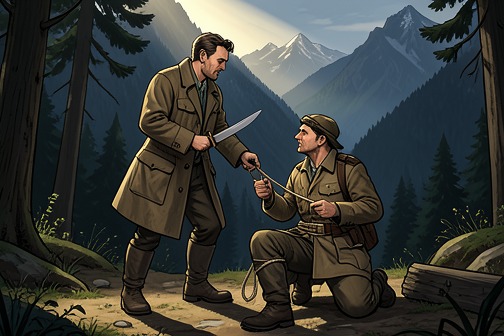
[Krantz’s death and the fulfillment of the curse](entity:event-recall-event-krantz-s-death-and-the-10722013dc2e) are the concluding movement of a hereditary punishment rooted in murder and a supernatural marriage oath. Wilfred’s judgment does not simply promise [Krantz](entity:character-recall-character-krantz-2ce5df9fe58b) a violent end; it condemns him to live while the people bound to the oath disappear, turning survival itself into the penalty and making his eventual death the final confirmation of the curse’s power.
## The Oath and Wilfred’s Judgment
Wilfred’s sentence follows Krantz’s double murder and the oath made under supernatural authority. When Krantz’s father attempts to attack the hunter, the axe passes through Wilfred’s form, revealing that ordinary violence cannot reach him. Wilfred then declares that spirits have power only over those who have committed murder and identifies the father’s crime as a double murder. The punishment is tied directly to the marriage vow: two of the father’s children are already gone, the third is destined to follow, and the oath is described as registered beyond any human attempt to revoke it.
The sentence reverses the ordinary meaning of mercy. Wilfred says that killing the father would be kindness, whereas his actual punishment is that he must live. The curse therefore works through delayed suffering rather than immediate execution. Its logic is cumulative: the father survives long enough to witness the loss of his children, and Krantz inherits not only the family history but also the expectation that the same supernatural account will eventually be settled through him.
## Flight to [Holland](entity:location-recall-location-holland-51dd34b9d27c) and the Father’s Death
After Wilfred disappears, Krantz’s father rises, embraces his child, and kneels in prayer. The next morning he leaves the cottage forever, taking Krantz with him and travelling to Holland. The flight is not a release from the curse but its first consequence, carrying the family’s unresolved crime into a new country and a new phase of Krantz’s life.
The fugitives reach Holland with a small amount of money, but their security lasts only a few days. In [Amsterdam](entity:location-recall-location-amsterdam-68440c77c10d), Krantz’s father is seized by brain fever and dies raving mad. Krantz is placed in an asylum and later sent to sea before the mast. These successive dislocations—escape, illness, death, confinement, and forced service—make the curse legible as a process rather than a single supernatural blow. The father’s life ends in madness, while Krantz is left alive, displaced, and increasingly isolated from any ordinary future.
## Krantz’s Foreknowledge and the [Curse](entity:state-recall-state-curse-d68bb839342a)’s Fulfillment
Krantz later recounts this history to [Philip](entity:character-recall-character-philip-f89be33d583c) and asks whether he himself must pay the penalty of his father’s oath. He is not merely fearful of death; he is convinced that the oath must claim him in some manner. That conviction gives his later death the character of fulfillment rather than surprise. The prophecy has already established its pattern through the disappearance of two children and the father’s forced survival, while Krantz’s own movements become a tense continuation of the same design.
The story places this hereditary doom beside the book’s wider supernatural framework, in which [All Souls’ Eve](entity:event-recall-event-all-souls-eve-0bee50e730b8) is the haunted night when the dead are reputed to rise and return home. Against that calendar of returning spirits, Wilfred’s judgment creates a different kind of recurrence: a spoken vow crosses generations, follows the family through flight, and converts death into the final proof that the past remains active. Krantz cannot simply begin again in Holland or at sea, because the oath makes his future answerable to an earlier crime.
## Tragic and Ritual Significance
The event completes a pattern in which speech, ceremony, and punishment possess material force. The marriage oath is made even in a wild country without a priest or ordinary law, yet Wilfred treats it as binding; the vow becomes an instrument of judgment, and its consequences outlast the place where it was spoken. In this sense, Krantz’s death is not an isolated end but the last stage of a ritualized chain linking marriage, murder, flight, madness, and survival.
The contrast with other public ceremonies in the narrative is stark. Feudal authority can enforce submission through proclamation and fines, while ecclesiastical and judicial institutions stage punishment before crowds; Wilfred’s supernatural tribunal requires neither marketplace nor church. Its verdict is carried by memory and time. Krantz’s death therefore closes the curse by demonstrating that an oath made outside recognized human institutions can still govern a life more completely than human law, exile, or physical distance.
Event 8
Krantz’s death by the tiger
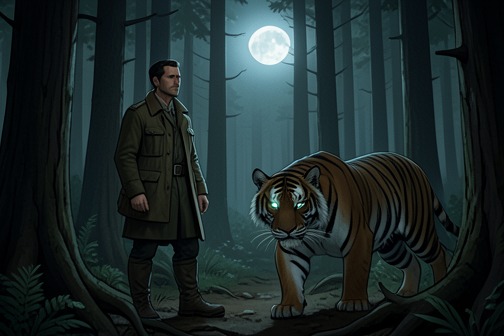
[Krantz’s death by the tiger](entity:event-recall-event-krantz-s-death-by-the-t-2b2ef25faa71) is the sudden culmination of [Krantz](entity:character-recall-character-krantz-2ce5df9fe58b)’s fatal presentiment during the voyage toward [Pulo Penang](entity:location-recall-location-pulo-penang-4222b3808505). In an apparently uninhabited landscape, a practical search for fresh water becomes the setting for an irreversible disappearance: Krantz is carried away by an enormous tiger, and [Philip](entity:character-recall-character-philip-f89be33d583c) is left to interpret the attack as the fulfillment of a doom already announced. The event gives the wider supernatural history of Krantz’s family its most abrupt and concrete consequence, while making Philip the bereaved witness responsible for preserving its meaning.
## Causes and Forebodings
Krantz and Philip are sailing through the Straits toward Pulo Penang after reaching the high land of southern [Sumatra](entity:location-recall-location-sumatra-bd065a3852f9). Their long exposure to the burning sun, dew-filled nights, and constant work has not damaged their health; with their beards and Muslim clothing, they could even have been mistaken for natives. Yet after Krantz has confided his family history to Philip, his character changes. His former liveliness disappears, and he becomes silent and melancholy, as though the telling of the past has brought its threatened future into the present.
When Philip speaks of their plans for [Goa](entity:location-recall-location-goa-4b350123a787), Krantz replies that he has a presentiment that he will never see the city. He rejects the suggestion that illness explains his fear, insisting that he is sound in body and mind. The warning, he says, returns continually, and he asks Philip to take possession of the gold hidden on his person. His request is not merely practical. Krantz presents it as preparation for death, explaining that some spirit may be warning him to prepare for another world and that he has lived long enough to leave life without regret, though separation from Philip and [Amine](entity:character-recall-character-amine-78cdf8ffeb99) would still wound him.
Krantz’s foreknowledge is strengthened by his account of dreams in which Philip and Amine meet again after further trials. In those visions, part of the ordeal is concealed from him by dark clouds, and an invisible presence refuses to reveal it, warning that knowledge would make him wretched and that Krantz will be summoned away before the trials occur. Philip treats these impressions as the imaginings of a disturbed mind, but Krantz continues to act upon them. His faintly smiling insistence that Philip may return the money if they arrive safely makes the request seem both rational and ominous: ordinary prudence is being used to prepare for an extraordinary death.
## The Attack in the Strait
The immediate circumstances are deceptively calm. The travelers are about forty miles north on the eastern side of the Strait, where rocky mountains descend toward low forest and jungle along an apparently deserted coast. After two hours of keeping close to shore, they discover a stream cascading from the mountains through the jungle into the Strait. They steer the peroqua to its mouth, lower the sails, and row against the current until they are certain that the water is fresh. The jars are filled, and the journey could resume.
Instead, the beauty and coolness of the place, together with weariness from confinement aboard the vessel, lead Philip and Krantz to bathe. They remove their Muslim clothing and plunge into the stream. Krantz emerges first, complaining that he feels chilled, and walks toward the bank where their clothes have been placed. Philip remains standing in water about waist-deep. Even at this threshold between water, shore, jungle, and sea, Krantz returns to the subject that has haunted him: he wants to pour the money from his sash so Philip can secure it in his own clothing.
Philip finally agrees to humor him. He is still treating the request as an absurdity when the scene changes without warning. A tremendous roar is followed by a rush through the air, a blow that knocks Philip onto his back, a cry, and a struggle. Recovering himself, Philip sees Krantz’s naked body carried away with the speed of an arrow by an enormous tiger. Within seconds both animal and man have vanished into the jungle. The attack provides no combat, rescue, or recovery; its violence lies precisely in its speed, leaving Philip with only the fact of disappearance.
## Witnessing and Immediate Aftermath
Philip’s response is one of devastated recognition. He cries out that Heaven should have spared him the sight and understands that Krantz’s presentiment has proved true. His friend, whom he calls his brother, has not merely died in an unpredictable accident from Philip’s perspective; the death has confirmed the warning that Krantz had repeated throughout their approach to the coast. Philip throws himself face down in agony and breaks into tears, turning the attack into an act of involuntary witnessing.
For more than an hour Philip remains fixed at the spot, indifferent to the danger around him. When he finally rises, dresses, and sits down again, his eyes remain fastened on Krantz’s clothes and on the gold lying in the sand. These abandoned objects are the material remainder of the conversation that Philip had resisted. The gold, intended as a precaution against an uncertain future, becomes a bequest made effective by death; the clothes mark the human form that the tiger has removed from sight.
The scene ends without a recovered body or an explanation that would settle the supernatural dimension. Philip concludes that Krantz foretold his doom and that destiny has fulfilled it. He also links the death to the spirit-hunter and his wolfish daughter, declaring that Krantz’s bones will bleach in the wilderness and that they have been avenged. His interpretation therefore joins the tiger attack to the family history already entrusted to him, transforming an isolated predatory assault into the latest consequence of a curse whose reach extends across continents.
## Narrative Function and Significance
The event is structured as a sharp movement from anticipation to revelation. Krantz repeatedly names the possibility of death, while Philip repeatedly minimizes it; the narrative then makes the warning literal at the moment when both men are occupied with water, clothing, and the transfer of money. The value at stake shifts from companionship and shared survival to irreversible separation. Philip’s expectation of reaching Goa with Krantz becomes grief beside an empty bank, and Krantz’s desire to protect his friend becomes the final act Philip can neither prevent nor repay.
The setting intensifies the horror through delay and exposure. The coast appears uninhabited, the stream offers relief, and bathing temporarily suspends the voyage’s hardships, but the jungle conceals an overwhelming force. The danger is first heard as a roar and felt as a blow before Philip can understand what has happened; only afterward does the visible tiger and its captive become clear. Terror therefore comes from foreknowledge and uncertainty, while horror arrives in the instantaneous image of a human body being carried away. The narrative withholds the final struggle and the corpse, preserving the jungle as a space that absorbs both the victim and the possibility of complete knowledge.
Krantz’s death also reverses the apparent logic of escape. He and Philip have crossed great distances and adapted themselves to the environments through which they travel, even appearing like local inhabitants in their Muslim dress. Their precautions, endurance, and route toward Goa suggest continued survival, yet none of these forms of competence can answer the fatal warning. The death is external in its immediate cause—the tiger’s assault—but it is prepared by an inherited supernatural history and accepted by Krantz as an unavoidable summons. Its final image is not a triumph over danger but the persistence of absence: clothes and gold remain on the sand, while Krantz disappears into the wilderness and Philip is left to carry the story onward.
Event 9
Gaspar de Marcanville’s final transformation and death
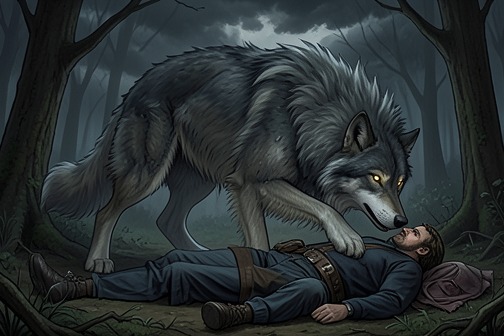
[Gaspar de Marcanville’s final transformation and death](entity:event-recall-event-gaspar-de-marcanville-s-f36b2c3973c0) is the decisive climax of his story: after years of exile, hunting, and grief, Gaspar appears as a large Wolf, kills the Count de Saintefleur, and is fatally struck while changing back into a man. His death reveals that the “Wehr-Wolf of [Limousin](entity:location-recall-location-limousin-92ef43f4c0a4)” is not merely a village rumor but Gaspar himself, and it turns his long struggle for justice into a victory immediately shadowed by annihilation.
## Causes and Background
Gaspar’s final appearance grows out of a history of political betrayal and forced withdrawal. After [De Saintefleur](entity:character-recall-character-de-saintefleur-13609fd06248)’s treachery, Gaspar was driven into exile with [Rosalie de Marcanville](entity:character-recall-character-rosalie-de-marcanvi-dce2d6a5b82a) and their daughter [Adéle de Marcanville](entity:character-recall-character-ad-le-de-marcanvill-1fc1045d9a62), taking refuge in the dark recesses of the Hanoverian Harz. He prepared a faithful account of the betrayal and obtained a certificate from his confessor, Father Ægidius, addressed to the King, so that his family might recover its rank and estates if Gaspar died during the dangerous journeys by which he supported them.
The exile hardened him into a hunter. Years spent in the Hercynian woods gave Gaspar considerable skill: the wild-buck could not escape his spear, and even the bear was too weak to resist him. His purpose was not simple self-preservation. He endured because Rosalie and Adéle still depended on him, making the chase both a means of obtaining food and an obligation to the family he was trying to protect. His grief over his fate repeatedly broke into violent passion and lamentation, and about ten years after the exile Rosalie died, leaving Gaspar a widower while Adéle was scarcely eighteen.
With Rosalie gone, Gaspar resolved to leave his solitude, return to France despite the danger of unrecalled exile, and place his papers before the throne. He intended to demand the Ordeal of Combat with De Saintefleur. Yet when he reached the wooded Province of the Upper Limousin, the changes wrought by ten years of severe labor and sorrow weakened his resolve. The event that follows therefore carries a double pressure: Gaspar has come close to public justice, but his altered body and ruined circumstances make a direct restoration of his former identity increasingly impossible.
## The Confrontation and Recognition
The climax begins when Adéle confronts the Count de Saintefleur and he identifies himself as her father’s ancient enemy. Adéle answers that the time of vengeance belongs only to Heaven. The declaration is immediately answered by a hoarse voice and the arrival of the creature that has haunted the story’s moral landscape: a large Wolf, already wounded by the loss of a fore-paw, leaps upon the Count and ends his existence.
The Wolf’s injury is a concrete link between the supernatural avenger and the human hunter behind the legend. It also distinguishes this killing from the generalized peasant fears attached to wolves and werewolves. Earlier traditions imagined such creatures as sorcerers who assumed wolf-shape through an enchanted girdle and then killed or consumed human beings; popular belief likewise attributed cemetery deaths and attacks to demonic agency. Here, however, the Wolf enters at the precise moment of Gaspar’s personal revenge, giving the inherited monster-form a specific history and a human grievance.
The action turns again when the royal train, discovered by the peasants, arrives with flambeaux. A Knight carrying a large partizan strikes at the Wolf. Adéle vainly tries to protect the animal, but the blow has enough force to destroy both the Wolf and the man into whom it is changing. The creature gives one terrific howl, falls backward, and is revealed in the form of a tall, gaunt man dressed as a hunter. The sudden change supplies the event’s recognition: the feared Wehr-Wolf is Gaspar de Marcanville.
## Death and Immediate Aftermath
Gaspar’s transformation is not followed by rescue or vindication. The weapon that kills the Wolf also kills the human form, collapsing supernatural punishment and ordinary violence into the same stroke. The Count de Saintefleur dies by the hand, or paw, of the avenger, while Gaspar dies at the moment his identity becomes visible to those who might have judged his cause.
Adéle completes the scene’s tragic reversal. Drawing a packet from her bosom, she offers it to the King and then sinks lifeless upon the body of her father. The packet connects Gaspar’s death with the documentary proof he had prepared during exile: his testimony and Father Ægidius’s certificate can finally reach the sovereign, but only after Gaspar has lost his life and Adéle has collapsed beside him. The papers preserve the possibility of legal recognition even as the family’s immediate future is marked by death.
The ending thus gives Gaspar the revenge he sought without granting him a return to his former social existence. His enemy is dead, his evidence is delivered, and the royal presence makes acknowledgment possible; nevertheless, the restored identity arrives too late to save him. The narrative’s promised return from exile becomes an inverted homecoming in which the survivor reaches the court only through the exposure and destruction of the monster within him.
## Folkloric and Narrative Significance
Gaspar’s death condenses the long development of the werewolf tradition into a literary scene of revelation. Earlier accounts describe werewolves as men allied with the Devil, capable of taking on the form and nature of wolves, while French tradition names them loup-garous or bisclavarets. The Limousin setting preserves that folklore directly: the Upper Limousin is presented as a region associated with Wehr-Wolves who leave their hills and mountains at midnight, running howling through nearby towns and villages.
The event also belongs to a broader movement from superstition into literature. Werewolf beliefs had passed through Greek, English, Italian, German, and French traditions; medieval poetry continued the lycanthrope legend, and nineteenth-century writing carried the monster from poetry into the short story. Gaspar’s final scene participates in that transformation by giving a named, socially displaced man the body of the legendary beast, then using the return to human form as the mechanism of recognition rather than as a route to survival.
Its strongest structural effect is the concentration of several reversals in sequence. Adéle’s appeal to divine vengeance is followed by the Count’s death; the apparent triumph of the Wolf is followed by the royal attack; the destruction of the animal reveals Gaspar; and the revelation that might have cleared his name is followed by his death. The werewolf form grants Gaspar the power to punish betrayal, but it also makes his justice indistinguishable from the very monstrosity that society fears. The final transformation therefore exposes both a man and a legend, while leaving the reader with a victory that can never become restoration.